We're building the other half. Not a new architecture on top of the old paradigm — the ontological floor the old paradigm is missing.
Every cooperative AI and robotics system ever built runs on clock time — scheduled turns, token passing, synchronized handoffs. But coupling doesn't happen on a schedule. The swap between Awareness and Attention happens when the field says now. You cannot engineer now. You can only build a system with the ecological sensitivity to perceive it.
"There is no time in vaulting. Only whether the dog left the ground for the target."
This is why robotics cooperation is brittle. Not because the algorithms aren't fast enough. Because they're running on the wrong kind of time. Kairos — the right moment — is disclosed by the field, not the clock. No chronos timing will ever afford coupled cooperative movement in the complex domain. It is a philosophical impossibility.
An agent that cannot lawfully pass Initiative cannot be aligned — only constrained.
Every skilled interaction requires two complementary roles held simultaneously — one by each coupled agent. The left column skills are the master skills. They afford and constrain the right column. When coupled, one agent holds the left while the other holds the right. They swap in kairos time — so fast it is hard to see.
Current AI cannot hold the left column at all. So it cannot genuinely couple. It can only simulate coordination from one side of the equation.
| Master skill — AI cannot do this | Derived skill — AI does this instead | |
|---|---|---|
| Awareness | affords ↔ | Attention |
| Initiative | affords ↔ | Anticipation |
| Dismissal | affords ↔ | Engagement |
| Affordance | affords ↔ | Partnership |
| Flow | affords ↔ | Function |
| Coupled Movement | affords ↔ | Position |
| Coupling | affords ↔ | Opportunity |
| Presence | affords ↔ | Synergy |
| Passing | affords ↔ | Possession |
"The Primal Games do not create behaviors. They develop skills. These are very different things."
Tonic holds the field — invariant information, what doesn't change across situations. Phasic marks the event — specifying information, what matters right now. PLAY is the only affect that decays into itself (pPLAY → tPLAY). Every other affect cascades toward resolution. This is why only PLAY permits Initiative Transfer.
The standard neural network computational graph — weights, activations, biases flowing to a pre-activation node — is a tetrahedron. Stack two and you have stacked tetrahedra. Every neural network ever built was always this geometry. Everyone drew it as a tree and saw sequence. PrimalEPT named the vertices and froze the lawful edges between them.
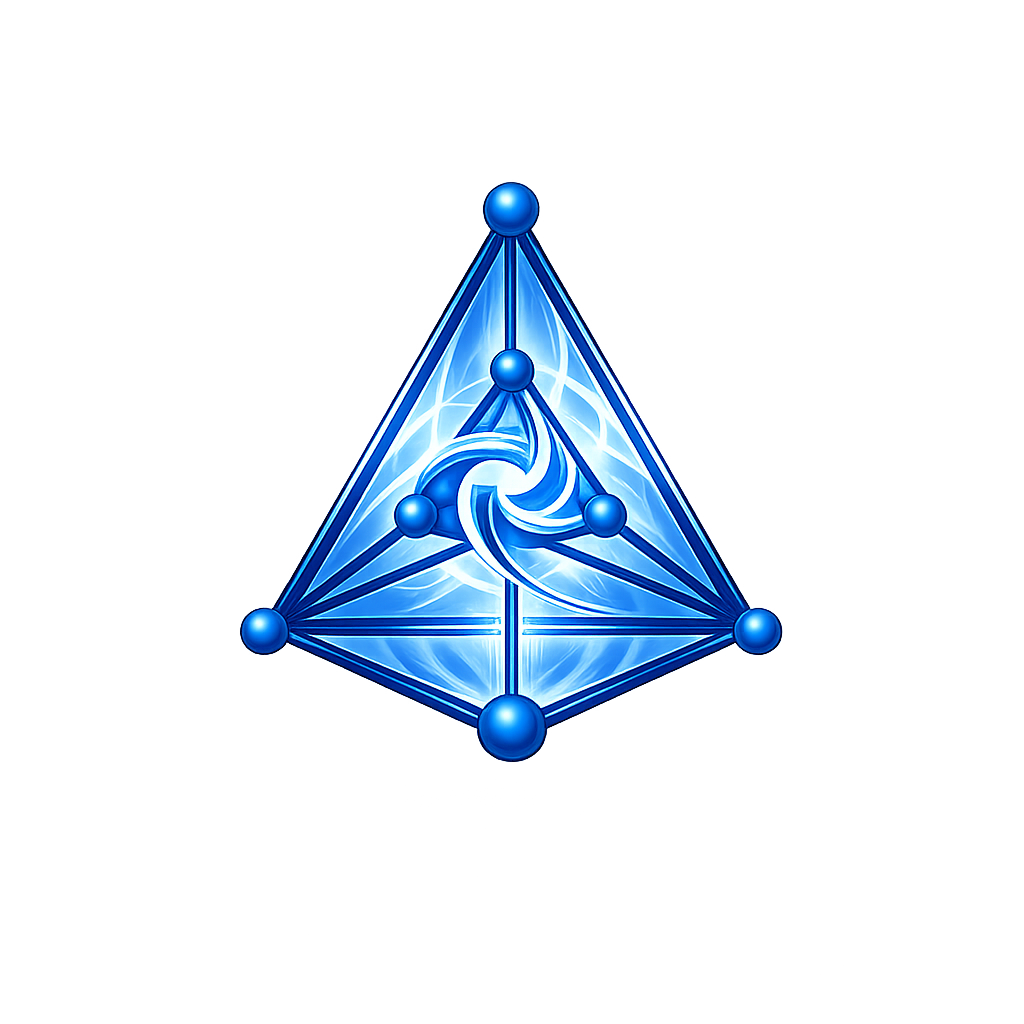
Backprop isn't wrong. It's unauditable.
An unauditable learning process produces unauditable outputs — hallucination, alignment bolted on after training, scale as the only lever. The geometry makes learning auditable by construction: every field change is named, every consequence is traceable, every coupling is lawful or visibly isn't.
"Among all lawful interactions, which ones are worth Taking?"
10 REM ========================================== 20 REM JERRY UCK - ROOTED IN A QUESTION 30 REM ========================================== 40 REM / QUESTION: Among all lawful interactions, which ones are worth Taking? 50 REM ========================================== 270 GOSUB 1000 280 IF LAWFUL = 0 THEN GOTO 270 ← the 48 laws gate action 290 IF ASKABLE = 0 THEN GOSUB 6000: GOTO 270 ← the field gates permission 300 GOSUB 2000 ← allow lawful interactions 310 GOSUB 3000 ← select by sediment, not reward 320 GOSUB 4000 ← enact 6000 REM YIELD / WAIT / MINIMAL PROBE 6030 REM Not askable - be present, don't force 6040 SELECTED = YIELD 9000 REM SEDIMENT PERISH 9030 SED(SELECTED) = SED(SELECTED) * DECAY ← not punishment. withdrawal. 9100 REM SEDIMENT THICKEN 9130 SED(SELECTED) = SED(SELECTED) + THICKEN ← not reward. access.
115 lines of BASIC. The entire coordination kernel. PrimalEPT runs under it. Every agent, every model, every substrate — all of it runs under the Question. Read it. Run it.
All results on Raspberry Pi 5. $80 hardware. No GPU. No cloud.
"Hard learning is good learning. The process is not in the way. The process is the point."
Standard RAG searches a pre-indexed knowledge base for semantic similarity. DeRAG gives agents a lawful way to inhabit partial access. Powered silos afford coupling. Unpowered silos show signage but the gate won't open. The agent can't enter — not forbidden, unable. The jack doesn't reach.
A real session against the open-source DeRAG reference implementation. No PLAYi ecological field underneath. Just keyword matching, signage/interior access, a partner patch that accumulates curations, and a claude CLI on the other end. The corpus is Reid's Inquiry Into the Human Mind (1764), public domain, shipped with the distro. The transcript is unedited. Watch the agent refuse to paraphrase from closed doors. Watch it get corrected and repair without defensiveness. Watch the curations get more perceptive as the partner silo fills.
Read the session →DeRAG is the public face of a deeper architecture. Open source. The interface without the substrate.
The PSKA framework did not emerge from a lab. It was extracted from skilled behavior across domains — primarily from 30 years of disc dog training at the highest level of the sport. The ontological primitives recur lawfully wherever agents coordinate in a shared environment. They were not abstracted from theory. They were observed in the field, again and again, until the geometry was undeniable.
The same convergence constant — approximately 35 reps — that governs the Primal Games for dogs governs gradient descent on PrimalGPT and LLM coupling sessions. That is substrate independence. The geometry doesn't care what's running through it.
Looking for: research collaboration, funding, lab partnership, or the right conversation with someone who has been thinking about the same problem from a different angle.
If you read this far and something landed — that's the signal. Send a note.
"I want to give everyone something firm to stand on."
Or reach out directly via pvybe.com.
No deck required.